Trans-PRK
Laser eye surgery without
contact or incisions

Trans-PRK is a modern laser eye surgery procedure in which your eye is not touched during treatment. The procedure is gentle and is performed “no-touch” using only the laser.
This laser eye treatment corrects your vision precisely and gently: painlessly and in just a few minutes.
On this page you will find everything you need to know about Trans-PRK:
How does the treatment work, what are the advantages and disadvantages of the procedure, what is the healing process like, how much does it cost, and how does it differ from Femto-LASIK and KLEx?
Non-invasive:
Trans-PRK is a gentle, superficial laser eye surgery procedure that does not require any incisions in the cornea:
Ideal for people with thin corneas or active lifestyles.
Safe:
The top layer of cells (epithelium) is precisely removed using an excimer laser:
This reduces the risk of complications.
Longer healing time:
The natural regeneration of the cornea takes about 3 to 5 days. During this time pain and temporary vision impairment may occur.
Long-lasting improvement:
Trans-PRK enables stable, precise, and long-lasting vision correction even for high diopter values and astigmatism.
Experience:
The method is scientifically proven and has been used successfully for decades:
It was developed by our founder, Prof. Dr. Dr. Seiler.
Trans-PRK stands for transepithelial photorefractive Keratectomy.
In this procedure, a laser completely removes the top layer of the cornea (the epithelium), then the cornea underneath is shaped to correct vision problems.
Depending on the laser manufacturer or clinic, terms such as SmartSurfACE, touch-free PRK, or cTEN are also commonly used, but technically they all refer to Trans-PRK.
In manual PRK, the top layer of the cornea is removed with a blade instead of a laser. Beyond that, the two procedures are identical.
No contact, no incision:
No weakening of the corneal structure.
Also suitable for thin corneas:
Trans-PRK allows laser treatment even when the cornea is too thin for LASIK or KLEx.
Wide range of applications:
Trans-PRK can correct nearsightedness and astigmatism. It can also be used to treat special cases (e.g., irregular corneas).
Cost advantage over Femto-LASIK:
Since Trans-PRK only uses an excimer laser, the procedure is less expensive than LASIK or KLEx. Details on the costs can be found here.
In summary, Trans-PRK primarily protects the cornea and offers the possibility of safely performing laser surgery even on difficult eyes.
You benefit from an established procedure with the highest precision.
up to –8 diopters
not recommended
up to 5 diopters
Trans-PRK can be used to treat nearsightedness (myopia) and corneal curvature (astigmatism).
Some providers also use Trans-PRK to correct Farsightedness (hyperopia). This is not recommended by the KRC (Commission for Refractive Surgery) and is therefore not offered by us:
At YOUSEE, the safety and health of your eyes always come first.
Trans-PRK is suitable for Nearsightedness up to approximately -8 diopters and corneal curvature up to approximately 5 dpt.
Patients with corneal curvature also benefit from Trans-PRK. The laser can not only compensate for nearsightedness, but also correct existing corneal curvature in the same step.
These figures are guidelines:
Actual suitability depends on your individual corneal thickness and eye condition. Together, we will find out which procedure is best for you.
Trans-PRK has been used successfully worldwide for decades and is the oldest and most established procedure..
In this video, our ophthalmologist Priv.-Doz. Dr. med. Dr. med. univ. Jascha Wendelstein explains everything you need to know about Trans-PRK.
The Trans-PRK procedure is a very safe and low-risk laser eye surgery procedure, especially when compared to other methods such as LASIK or SMILE, as no incision is made and the treatment is completely contact-free.
As with any surgery, there is a small residual risk, but thanks to careful diagnosis in advance and experienced surgeons, serious complications are extremely rare.
It is crucial that the treatment is only performed on suitable candidates
Incidentally, our internal guidelines for selecting suitable candidates are stricter than the international standard:
This allows us to further minimize the risk.
Summary: Trans-PRK is an effective and reliable solution for permanently eliminating the need for glasses and contact lenses.
* Free consultation with our trained, non-medical specialists.
If you would like to know whether you are suitable for Trans-PRK, please arrange a free* and non-binding consultation with us. We will be happy to take the time to talk to you.
Thin or irregular cornea:
If you have a relatively thin cornea, cutting a flap or lenticule can be risky. Trans-PRK does not require any incisions.
Active athletes and certain occupational groups:
If you practice martial arts, ball sports, or water sports, or if you work in the army, police, or fire department, for example, a corneal flap can pose a safety risk. Trans-PRK and KLEx are safe alternatives in these cases.
Note: Trans-PRK is often used when other methods are not possible for medical reasons, but this does not mean that Trans-PRK is unsafe. On the contrary:
Studies confirm that Trans-PRK is a very safe and effective procedure, and our internal evaluation also comes to this conclusion.

You should ...
Be at least 18 years old (ideally between 20 and 45 years old)
Have had largely stable vision for at least 12 months
have no active eye diseases (retinal diseases, corneal diseases, etc.)
have sufficient corneal thickness (measured by us)
not pregnant, not breastfeeding
Be generally healthy (e.g., no uncontrolled autoimmune diseases)
If some of these points do not apply to you, this does not automatically mean that we cannot help you.
In many cases there are alternatives: if Trans-PRK is not an option for you, the insertion of an intraocular lens (ICL) could be considered, for example.
We will advise you honestly and in detail about your personal options. However, your safety is always our top priority:
We will only recommend Trans-PRK if everything is suitable for you.
Trans-PRK treatment is performed on an outpatient basis and takes only a few minutes per eye. You will be awake the entire time, but can be given a mild sedative if desired.
Before the procedure begins, your eyes will be thoroughly examined. Among other things, the thickness of your cornea, pupil size, and visual defects will be measured so that the laser can be programmed with the highest precision for you individually.
On the day of the operation, you should arrive without makeup, well-rested, and without contact lenses.
With Trans-PRK, both eyes are treated in one session:
This is standard practice, safe and much more convenient for you.
First numbing eye drops are administered so that you will feel no pain, then the eye is disinfected and cleaned. On the operating table, you look up into the laser microscope, and a small light helps you to fix your gaze. Now the actual Trans-PRK treatment begins.

Once the anesthetic has taken effect and your eye is fixed in place, the excimer laser starts. First, it gently vaporizes the top layer of the cornea (epithelium) on the area to be treated. This only takes a few seconds, during which you continue to look at the fixation light. The layer that is removed in this way grows back completely after three to four days.
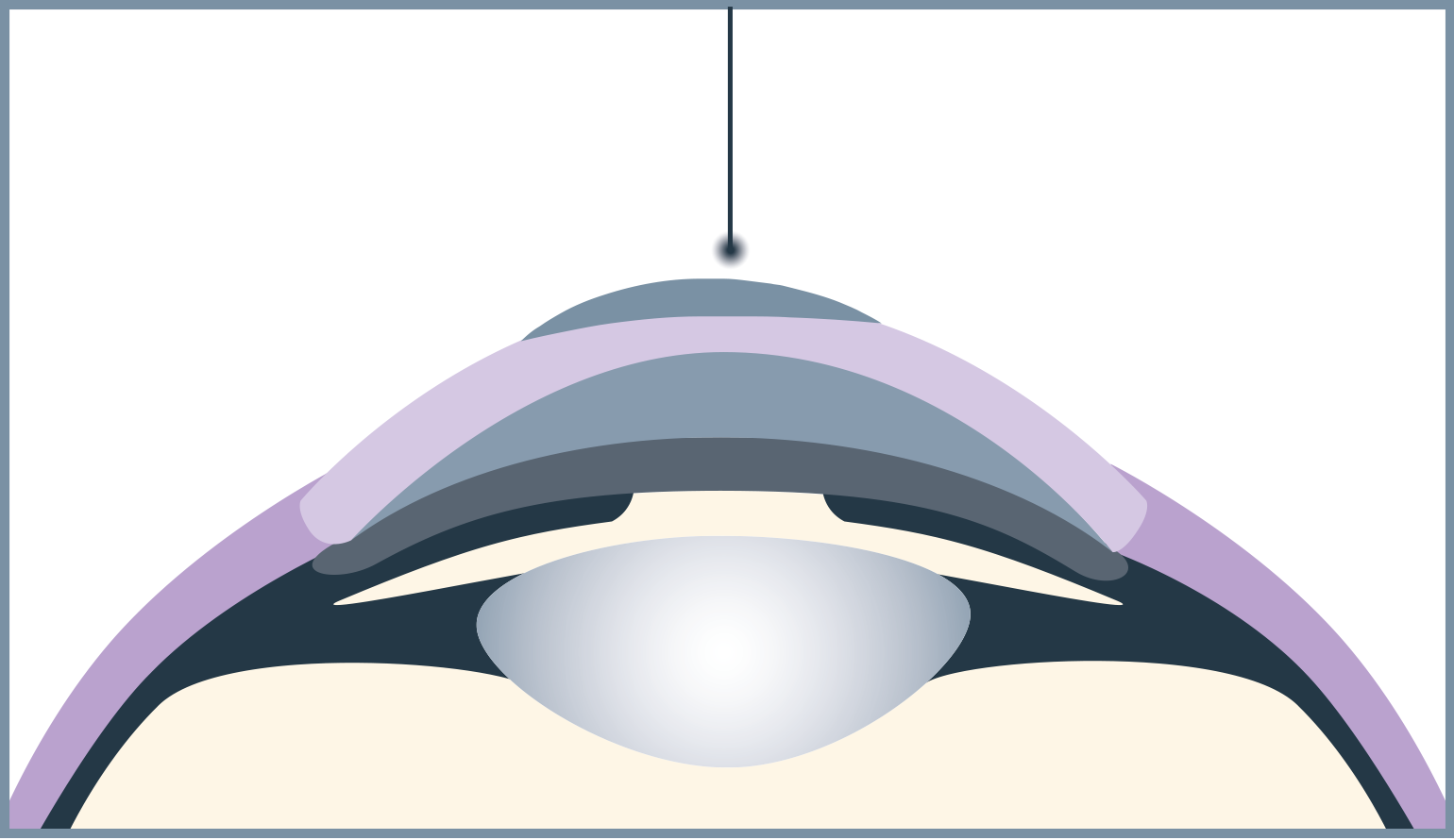
Based on the previously measured values, the laser now removes microscopic layers of the cornea. This changes the curvature of the cornea so that incoming light is focused precisely on the retina: your vision becomes sharp. The process is computer-controlled and extremely precise, taking around 20 to 60 seconds depending on the correction (as a rough guide, approx. 2 seconds per diopter of visual impairment). You will not feel anything during this step, but there will be a smell of burnt tissue.
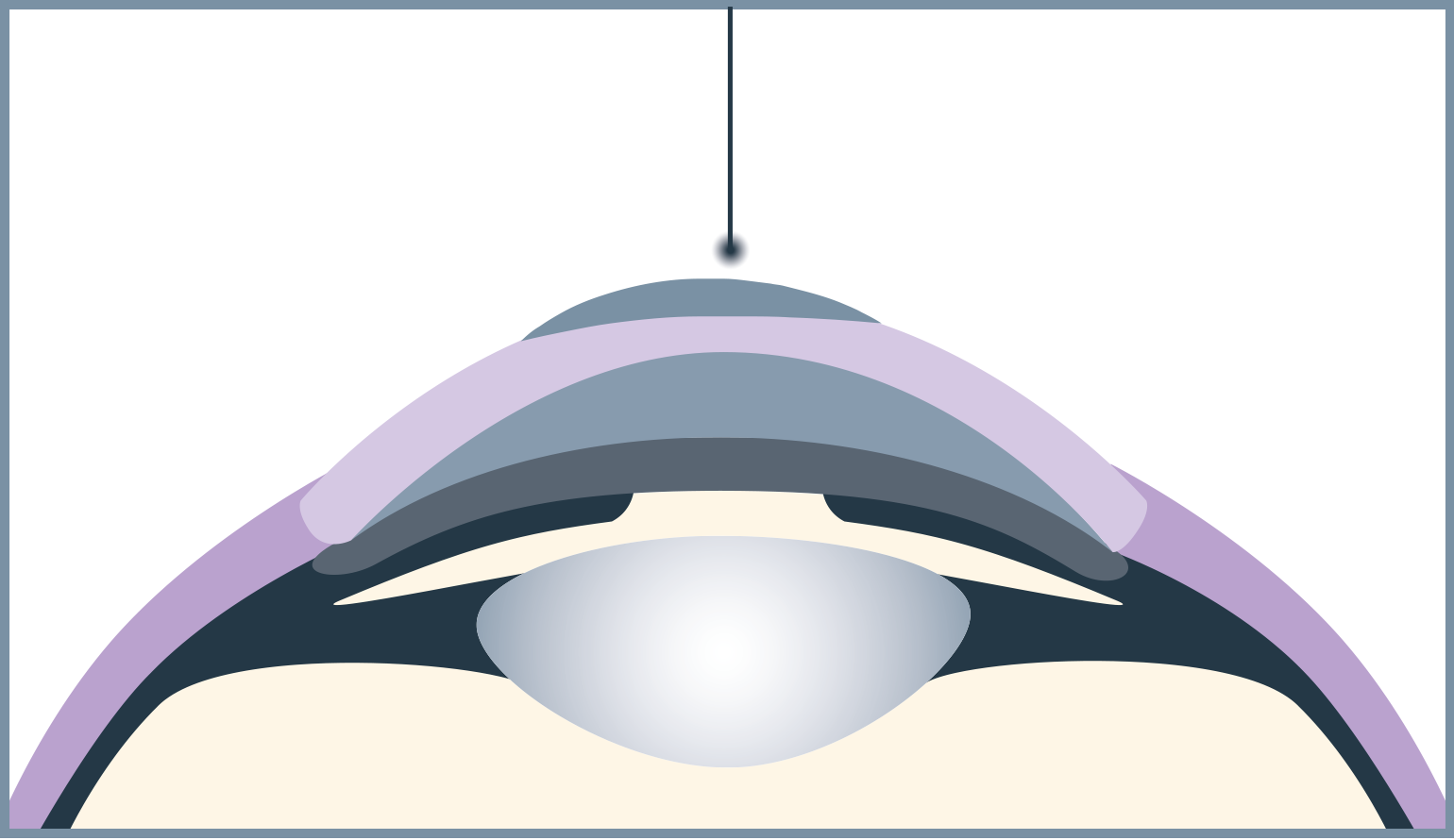
That's it: once the laser has done its job, the operation is over. Your doctor will rinse your eye and place a therapeutic contact lens on your cornea. This special bandage lens serves as protection and pain relief while the epithelium grows back over the next few days. We will provide you with eye drops (antibiotics to prevent infection, anti-inflammatory drops to prevent clouding, and artificial tears) for aftercare.

If you accidentally blink or move your eye, an eye-tracking system registers this in real time and the laser beam compensates for the movement. If this is not possible, it automatically interrupts the treatment in a matter of milliseconds.
During the treatment, we will talk to you and guide you through each step. Many of our patients are surprised at how quickly and unspectacularly everything goes.
Immediately after the surgery, you can relax at our clinic while we discuss the aftercare with you once again. We will then arrange your first follow-up appointment and give you an emergency number that you can use to reach us at any time.
Since your vision will still be blurry immediately after the laser treatment, we recommend that you have someone pick you up or come to us with an accompanying person.
On the day of the operation, it is normal for your eyes to water a little, burn, or feel like there is something in them.
The first 24 to 36 hours after Trans-PRK are associated with pain as the upper layer of the cornea grows back. We will give you medication to relieve the discomfort.
After Trans-PRK, you will be very sensitive to light, so it is advisable to avoid exposure to the sun for the first few days after the treatment.
At home, it is best to rest with your eyes closed.
It takes a few days after Trans-PRK surgery before you can see clearly. It is therefore best to bring someone with you to your surgery appointment so that you can get home safely.
Since your vision will only improve noticeably after a few days with Trans-PRK, we recommend that you take a week off work.
For your safety, we will discuss with you during your check-up after four days when you can drive again. This is usually possible after about seven days.
Immediately after the operation, your eye will still feel numb due to the anesthesia. Once the effects wear off, you may experience pain, burning, and tearing, and most patients are also sensitive to light. The bandage contact lens will remain in your eye until your follow-up appointment (after 4 days).
We will provide you with eye drops to use until your follow-up appointment. The sterile artificial tears relieve the feeling of dryness, while antibiotic and anti-inflammatory drops help prevent infection and support healing. We will also give you tablets to relieve pain and reduce inflammation. These will make the pain bearable in the first 24 to 36 hours after Trans-PRK. We will give you protective goggles to wear while you sleep so that you do not accidentally rub your eyes at night.
It is important that you do not rub your eyes in the first few days.
regular drops
do not rub your eyes!
The first few days are the most uncomfortable: your eyes are sensitive to light, feel scratchy, and your vision is blurry. Healing is quick: within about three days, the surface of the cornea is completely regenerated and the discomfort subsides. It is important to use the drops regularly. Do not rub your eyes and avoid dusty or very humid environments.
It is best to avoid direct sunlight for a few days, or even weeks, and wear sunglasses with UV protection when outdoors, as the cornea may still be sensitive to light during the healing phase.
Eye makeup (mascara, eyeshadow, etc.) should be avoided for a week to prevent particles from getting into the eye. However, we will discuss all of this with you again in person.
Continue to use drops
do not rub your eyes
take regular breaks
avoid dusty or humid environments
wear sunglasses
no water in the eyes for 7 days
no eye makeup
On the fourth or fifth day after your surgery, you will come in for your first follow-up appointment, at which point the bandage contact lens will be removed. Your vision will probably still be a little blurry, but it will improve.
From day four onwards, you can usually shower and wash your hair as normal again.
We will give you drops to help the healing process.
After a week, you can also swim, go to the sauna, and participate in higher-risk sports again, but please only after consulting us.
Continue to use drops
do not rub your eyes
wear sunglasses
feeling of dryness is normal
fluctuations in vision are normal
swimming, sauna, and sports are possible again
In the first and second week after the operation, your vision will gradually improve. Many patients achieve approximately 80% of their final visual acuity after seven to ten days. Your eyes may still be dry, so continue to use the eye drops as prescribed.
visual acuity at approximately 80%
cosmetics can be used again
Your full vision will be restored no later than four weeks after the operation. You will then have another check-up appointment, during which we will examine your vision and cornea. Continue to wear sunglasses, as UV protection is particularly important during the first three months, but should be taken seriously by everyone.
visual acuity at 100%
UV protection remains important: wear sunglasses!
Approximately three months after the surgery, the healing process is complete and your vision is stable.
A final check-up can be carried out after 6 months to verify the final result.
In rare cases, minimal residual visual impairment may remain. If this is bothersome, we can perform a follow-up correction (enhancement). However, with YOUSEE, this is not necessary in over 99.4% of cases.
healing complete
follow-up appointment possible after 6 months
We also recommend an annual check-up to ensure your vision and the health of your eyes in the long term. If any problems arise, please contact us immediately. However, everything usually runs smoothly.
The improvement in vision achieved by Trans-PRK is permanent. The treated refractive error or astigmatism does not usually return, and the result remains stable for life.
In rare cases, a small portion of the corneal tissue may regenerate, resulting in minimal residual refractive error. Experience has shown that this mainly affects patients with very high initial diopters and usually occurs within the first few months. If your visual acuity is not completely satisfactory over time, follow-up treatment is possible. YOUSEE will cover the cost of such corrective procedures for you, provided they are medically indicated.
We are only satisfied when you are.
However, no laser eye surgery can stop the natural aging process: from around the mid-forties onwards, the lens in the eye becomes less flexible in most people due to age. This condition, known as presbyopia, means that at some point you will need reading glasses, even if your distance vision remains sharp.
Trans-PRK cannot prevent presbyopia.
However, there are solutions for this (e.g., monovision), which we will be happy to inform you about when the time comes. The important thing is that you can now enjoy freedom from your glasses.
99.4% of YOUSEE patients are happy with the results of their laser eye treatment and enjoy a new attitude toward life full of spontaneity and comfort.
The success rate of Trans-PRK during the first procedure at YOUSEE is 99.4%, while the global success rate is 94.1%.
There is no single best procedure, but there is the ideal procedure for you: Here you will find information about the advantages and disadvantages of Trans-PRK.
Once you have laser treatment, you can see clearly at all distances without glasses or contact lenses.
No more fogged-up glasses or lost contact lenses: simply a better quality of life!
Trans-PRK enables laser treatment even when the cornea is too thin for other procedures such as Femto-LASIK.
PRK was developed and continuously optimized by our founder, Professor Dr. Dr. Theo Seiler. The modern laser we use at YOUSEE enables particularly smooth ablation. This ensures faster healing and better vision quality immediately after the operation.
No contact, no incision, Trans-PRK is gentle on the tissue and there is no pressure on the eye. The very rare risks
associated with a flap (e.g. displacement) do not apply here.
Our modern excimer lasers are extremely precise and feature various safety systems.
Numerous studies confirm the safety and effectiveness of Trans-PRK. Complications are rare and satisfaction rates are high.
Trans-PRK can correct nearsightedness and astigmatism and is also used for very irregular corneal surfaces.
Since Trans-PRK only uses an excimer laser, the procedure is less expensive than Femto-LASIK or KLEx. You can find details about the costs under the menu item Laser eye surgery costs.
Trans-PRK protects the cornea and offers the possibility of laser treatment even for demanding eyes. Once healed, there is no risk of the flap slipping, even in the event of a fall or blow to the eye, making Trans-PRK the first choice for martial artists or members of the military or police.
You benefit from an established procedure with maximum precision that is also more affordable than other methods.
Trans-PRK is minimally invasive, but it is still an operation. Like any method, it has its limitations and potential disadvantages, which we would also like to discuss. Although most of our patients are completely satisfied, it is important to be informed:
As successful as Trans-PRK is, no reputable doctor can guarantee a completely perfect result. In rare cases, a slight residual vision impairment may remain. Follow-up treatment can usually correct this, but a minimal residual need for vision aids cannot be completely ruled out.
With Trans-PRK, you need to be patient until full visual acuity is achieved.
In addition, the healing process is more uncomfortable in the first two to three days than with Femto-LASIK or KLEx.
Trans-PRK does not protect against natural age-related vision loss. This means that from around the age of 45, you will probably need reading glasses,
even if your distance vision is and remains perfectly corrected.
This is not a fault of the surgery, but the normal course of time.
In summary, the advantages of Trans-PRK far outweigh the disadvantages, which is why this method has been used successfully for decades.
Of course, we will discuss all the advantages and disadvantages with you openly in advance and address your individual situation so that you can make an informed decision at your leisure.
Although very rare, there is a possibility of complications with any surgical procedure. Serious problems are extremely rare with Trans-PRK. Your safety is always our top priority: we carry out particularly extensive preliminary examinations to minimize risks.
Overview of potential risks:
In rare cases, slight clouding of the cornea, known as haze, may occur after surgery. This is caused by tissue reactions during healing. Thanks to modern technology and medication, haze has become very rare today:
According to a study from 2024, haze occurs in only 1% of cases.
Haze can be treated with eye drops and will recede. In rare exceptional cases, however, further surgery may be necessary.
YOUSEE takes preventive measures so that you hardly need to worry about this.
Dry eyes can occur after laser treatment because nerves in the cornea are severed. This is typically temporary and can be treated effectively with eye drops. Some studies suggest that PRK is less likely to cause chronic dryness because no nerves are severed.
The success of Trans-PRK also depends on you being careful and patient in the first few weeks. You cannot
get back to your normal routine straight away, but should allow yourself time to rest. Sports, swimming, saunas, etc. are only allowed gradually
(see above).
Strict adherence to aftercare is an important part of the treatment. The risks associated with Trans-PRK are no higher than with other laser procedures, but they are of a different nature. Complications are very rare and are kept to a minimum by our experienced surgeons and modern technology. The disadvantages are mainly related to comfort:
The first few days can be uncomfortable, and vision is not immediately optimal.
However, the result is as precise as with other procedures.
Serious complications leading to significant and permanent vision impairment are extremely rare with Trans-PRK (in the per mille range). Blindness is not a possibility at all. It is important that you follow all aftercare recommendations and, if in doubt, come in for an additional check-up.
We do everything we can to ensure that you achieve the best possible result without complications. However, if something unexpected does happen, we are always there for you and can help quickly and effectively. The health of your eyes is always our top priority.
A word about the responsibility of laser eye surgery centers:
In a comprehensive test (2024), Stiftung Warentest emphasized the importance of careful preliminary examinations and transparent consultations before laser surgery.
We take this responsibility very seriously.
You can rest assured that we will only treat you if we are convinced that it is safe and appropriate in your individual case.
Don't hesitate to ask us critical questions:
We will be happy to answer them honestly.
You may have heard of alternative laser eye surgery procedures, such as KLEx (often marketed under the brand name ReLEx SMILE) or Femto-LASIK. How do these procedures differ from Trans-PRK, and which is the best?
Important: When performed correctly, all common procedures yield similarly good results in terms of visual quality. The main differences lie in the procedure itself and the healing time. Here is a brief overview:
In Femto-LASIK, a laser is used to prepare a thin corneal flap, which is then replaced. In Trans-PRK, on the other hand, the uppermost cell layer (epithelium) is completely removed and the laser works directly on the layer underneath. This eliminates the need for a flap incision, which is advantageous in cases of thin corneas.
However, since the removed cell layer must grow back, the healing phase for Trans-PRK is longer than for Femto-LASIK. Trans-PRK is mainly used when LASIK is not an option for medical reasons (e.g., very thin cornea) or for certain occupational or athletic requirements where the flap could pose a safety risk.
Trans-PRK removes the top layer of the cornea (epithelium) and shapes the underlying corneal stroma with a laser. It does not require any incisions, but does require a longer recovery time.
KLEx (often referred to as ReLEx SMILe©) is the latest laser eye surgery procedure, in which a tiny corneal lenticule (a small piece of tissue) is created inside the cornea using a laser and removed through a small incision.
In short: Trans-PRK works on the surface of the cornea, while KLEx works inside it. This means that healing is faster with KLEx and visual acuity is restored sooner.
All of the laser procedures mentioned—Femto-LASIK, Trans-PRK, and KLEx—have the same goal and consistently achieve it in suitable candidates. The visual results are equally good after six months at the latest for all procedures.
There is no single best procedure, but there is the best procedure for you: Together we will find it.
One of the most common concerns among patients is the cost of treatment: since health insurance companies in Germany and Switzerland classify refractive laser surgery as a voluntary service that must be paid for out of pocket, patients usually have to pay for their Trans-PRK themselves. Statutory health insurance companies do not cover the costs, while private health insurance companies often reimburse a portion of the costs, depending on the tariff: It is worth inquiring individually, but what amounts can you expect to pay?
Important: At YOUSEE, all preliminary examinations, the operation itself, and all follow-up checks are included in the price.
Transparency is very important to us: With us, you will know exactly what costs you will incur in advance, with no hidden fees or surcharges. You will not be charged for any follow-up treatments either.
Perhaps you have seen a significantly cheaper offer from a competitor abroad (such as laser eye surgery in Istanbul)?
Of course, there are good doctors all over the world, but when it comes to your eyes, price should not be the most important factor.
The most important factors are the experience of the surgeon, the quality of the laser technology, and comprehensive on-site care. In Germany and Switzerland, very high medical standards apply, and you can be sure that they are adhered to.
We understand the desire to save money, of course, but we repeatedly see patients coming to us after cheap deals with complications or unsatisfactory results. Laser eye surgery also requires comprehensive aftercare and a dedicated contact person you can trust.
Finally, we would like to address some frequently asked questions that we encounter time and again during consultations. Can't find yours? Contact us or drop by: We're happy to take the time to help you.
You will not feel any pain during the treatment, as your eyes will be numbed with drops. The first two to three days after the treatment may be uncomfortable (foreign body sensation, burning, tearing). Pain sensitivity varies from person to person, but medication can be used to relieve it. It will improve significantly by day four at the latest.
Not usually. We have summarized everything you need to know about the costs of a laser eye surgery here.
Under certain circumstances, yes. We have summarized everything you need to know about the costs on our website
Laser Eye Surgery Costs.
After PRK, plan to take at least a week off work. Many take two weeks off to be on the safe side and recover without stress. Getting a doctor's note is difficult: laser eye surgery is an elective procedure, meaning it is not medically necessary.
The correction of the cornea is permanent. Your cornea remains stable in the shape that the laser has modeled. In rare cases, minimal changes may occur in the first few months (e.g., the eye goes from 0 dpt to -0.25 dpt), but major relapses are uncommon.
The preliminary examination takes about two hours. The laser only takes a few seconds (depending on the strength of the correction).
With preparation and short breaks, you will spend about 10–15 minutes per eye in the operating room. On the day of the operation, you will be with us for about an hour, including preparation and rest time. So it's pretty quick: much quicker than you might think.
YOUSEE has state-of-the-art technology and a highly experienced team of specialized ophthalmologists. Our founder, Professor Dr. Dr. Theo Seiler, invented laser eye surgery and performed the world's first laser eye surgery in Berlin in the 1980s.
Above all, however, our experience and care are important: our doctors have performed many thousands of laser eye surgeries, and our entire team will look after you with sensitivity before, during, and after the procedure. We take time for your questions and concerns: from the initial consultation to the final follow-up check. Transparency, quality, and humanity are our guiding principles.
We also offer attractive financing options and work according to the highest medical standards (hygiene, safety, continuing education).
In short: With us, your eyes are in the best hands. We would be happy to convince you of our expertise in a personal consultation. You can find a detailed answer under the menu item Why YOUSEE?
Yes, once healing is complete, you will no longer need visual aids in everyday life. Despite laser treatment, you will probably need reading glasses for close-up vision from around the age of 40.
However, you will still have sharp distance vision.
Yes, follow-up treatments are possible, but only very rarely necessary. In the event of significant under- or overcorrection, laser treatment could be repeated after a few months.
Many people have this concern, but you can rest assured: blinking is impossible because a special eyelid holder keeps your eye open during the operation. The modern laser system registers eye movements at lightning speed and adjusts the laser beam in real time or stops it if necessary. Even if you move suddenly, the laser would pause immediately. The technology is designed so that small, natural eye movements have no negative impact. Our team will explain exactly what you need to pay attention to in advance.
In short: no. This has never happened anywhere in the world.
Trans-PRK is a proven and very safe laser eye surgery procedure.
If you are willing to accept a slightly longer healing time, Trans-PRK can permanently improve your vision and allow you to enjoy life without glasses or contact lenses.
Curious? Feel free to schedule a free* consultation appointment with us. Together, we will find out whether Trans-PRK is the best procedure for you. By the way, the appointment is not only free of charge, but also non-binding.
We advise, you decide: at your leisure and without pressure.
* Free consultation by our trained, non-medical specialist staff
